Tuesday, June 16, 2015

Scottish Whisky and Sticky Toffee Pudding

I just came home from my trip to Glasgow, Scotland. It is a wonderful city full of history, friendly people, delicious food, and whisky. So much whisky...Luckily, I'm a whisky afficionado so I felt right at home. 

I've learned in Scotland, it is spelled "whisky". In the US and Ireland, it's spelled "whiskey". To honor the Scots and their gift of whisky, I will use the proper Scottish spelling. (I also have a penchant for their crafted beers, but that is a post for another time.)

Scotland has 5 major whisky regions: Lowland, Highland, Speyside, Campbelltown, and Islay. Every area has its own distinctive flavor profile. I love all Scotch whisky, but I especially prefer those from the Highlands and Islay.

Whisky from Islay is known for the strong peaty and char nose while whisky from the Highlands is more prevalent in apple, pear, and vanilla notes. Whisky from Lowlands tastes of citrus and lightness. On the other hand, whisky from the Speyside region elicits a more pronounced cooked orchard with a hint of smoke.

Each region, although distinct from the other, appeals to me. My favorite Lowland SW is Auchentoshan; my choice from The Highlands is Oban and Talisker. From Speyside I like Glenfiddich and from Islay, I love 16 YO Lagavulin and Bowmore.
Most people enjoy whisky on its own, but I've found it to be dessert-friendly. In fact, Auchentoshan with dark chocolate truffles is out of this world.
Another dessert that pairs well with whisky is sticky toffee pudding. One of my favorite desserts in Glasgow and Edinburgh, it was served warm in a toffee sauce with ice cream on the side. With its butterscoth and caramel tones, this dessert goes well with a Highland Whisky like Oban, Glenmorangie, or Dalmore. Delicious!

Here is my version which I tried my first night back from the trip. Enjoy!

Sticky Toffee Pudding
Serves 8

Ingredients 
Pudding Cakes
170 g (1-1/4 Cups) Whole medjool dates, pitted, cut crosswise into 1/4-inch pieces
235 gm (1 Cup) Boiling water
1 Tsp Baking soda
170 g (1-1/3 Cups) Unbleached all-purpose flour
1 Tsp Baking powder
1/2 Tsp Salt
110 gm (1/2 Cup packed) Dark brown sugar
1 Large egg
1 Tsp Vanilla extract
1/2 Tsp Ginger powder
1/2 Tsp Cinnamon powder
1/4 Tsp Clove powder
1 TBSP Molasses
60 gm (4 TBSP) Unsalted butter, melted
100 gm (1/3 Cup +1 TBSP) Milk

Toffee Sauce
60 gm (4 TBSP) Unsalted butter, softened
110 gm (1/2 Cup) Packed brown sugar
75 gm (1/3 Cup) Heavy cream
2 TBSP Scotch whisky
1 Tsp Molasses

Vanilla ice cream

For the Pudding Cakes: 
1. Preheat oven to 350°F.
2. Grease and flour eight 4-ounce ramekins.
3. Set prepared ramekins in large roasting pan lined with a piece of paper towel. Bring large saucepan of water to boil. Keep at a simmer until you are ready to make the water bath.
4. In a bowl, mix dates with 1 cup of boiling water and baking soda. Soak for 5 minutes.
5. Using a strainer, drain the dates over a bowl, reserving the liquid. Transfer to medium bowl.
6. In a medium bowl, whisk together the flour, baking powder, and salt. Set aside.  
7. In a food processor fitted with the blade attachment, add the brown sugar and half the soaked dates. Pulse just until blended. Add the reserved soaking liquid, egg, vanilla, spices, and molasses to the food process. Process the entire mixture until smooth, about 5 - 10 seconds. The mixture will have no lumps and will be very fluid.
8. Through the feed tube, slowly add the melted butter and mix for about 10 seconds or until thoroughly combined. Transfer this mixture to bowl with remaining softened dates.
9. Using a spatula, mix the remaining softened dates with the batter.
10. Gently fold the dry ingredients into the batter, alternating with milk. You want to fold everything just until it's combined and the date pieces are evenly dispersed throughout the batter. Distribute batter evenly among prepared ramekins.
11. Place the roasting pan in the oven. Fill roasting pan with enough boiling water to come halfway up sides of ramekins. (It is easier to fill the roasting pan with water once in the oven as opposed to filling the roasting pan first and then transferring to the oven.)
12. Cover pan loosely with aluminum foil.
13. Bake pudding cakes until puffed and small holes appear on surface, about 35 minutes.
14. Immediately remove ramekins from water bath and cool on wire rack for 10 minutes.

For the Toffee Sauce: 
1. In a medium saucepan over medium heat, add the butter, sugar, and heavy cream. Whisk until smooth. Continue to cook once everything is melted, stirring occasionally, until sugar is dissolved and mixture looks puffy, 3 to 4 minutes.
2. Keep the mixture on the heat and slowly add the whisky and molasses. Whisk just to combine. Reduce heat and simmer until frothy, about 1 minute. Remove from heat. Pour 1 TBSP of toffee sauce over each pudding.
3. To serve, rewarm puddings in microwave if cold. Invert each ramekin onto a plate or shallow bowl.
4. Serve with a small ladle of sauce and good ice cream.


Monday, May 11, 2015

Angel Food Cake with Brown Butter and Berry Soup

Spring is in full bloom. Finally! Rows of arugula, kale, cilantro, Italian parsley, and marigolds are sprouting in my little green house. 

The compost that aged for a whole year is black like devil's food cake and smells fragrantly like the earth. I spent the beautiful Spring days tilling the potager soil and redefining the flower beds. The chickens are clucking out of spring happiness and scratching for worms. 


Spring is a happy time. The trees explode with flowers; life sprouts everywhere. 


I love the Spring fruits and vegetables. One of my favorite desserts in the Spring is a piece of wonderfully light angel food cake with brown butter served with cold berry soup. Sometimes I finish the soup with a splash of Prosecco. Delicious! 


Angel Food Cake with Brown Butter
For a 10" pan

Ingredients:
½ tsp Salt
140g All-purpose flour, sifted
½ tsp Baking powder
300 g Egg whites
2 tsp Cream of tartar
200 g Sugar
142 gm (10TBSP) Beurre noisette (browned butter)
1 Vanilla bean

Instructions:
1. Preheat the oven to 350°F.

2. Make the Beurre noisette: In a saucepan over medium heat, melt the butter. Continue cooking the butter until it boils. After about 5 - 10 minutes the butter will start to brown. It is best when it is darker brown and has tiny dark specks. The specks give the browned butter its flavor. Once you reach this phase, remove from heat and let cool.

3. Make French meringue: In a stand mixer fitted with whisk attachment, whip egg whites and cream of tartar until medium to stiff peaks.
4. Carefully fold the sifted dry ingredients in the French meringue in thirds. Folding it in all at once will deflate the batter.

5. Mix (sacrifice) a large spoonful of batter with cooled beurre noisette. Add this to the rest of the batter and fold in to fully incorporate.

6. Pour batter into an ungreased 10” angel food cake pan and bake for 15 minutes. The cake is done when it springs back when touched and skewer comes out clean. It will not pull away from the sides of the pan. Invert angel food cake over a baking rack until cool.

Variations:

●You may pipe batter on greased small 4oz pans or ramekins. Bake for 10 to 12 minutes.

Berry Soup

Serves 8

455g Strawberries, cleaned and hulled 
295g Blueberries, cleaned
365g Raspberries
170g Blackberries
1 Mint sprig
125mL Red wine, dry (I prefer cabernet)
90g Sugar

1. In a large pot, combine the strawberries, blueberries, raspberries, blackberries, mint, wine, and sugar. 

2. Bring to a boil over medium heat.

3. Lower heat and simmer for 30 min.

4. Chill in refrigerator overnight.

5. The next day, strain the mixture through a cheese cloth. Be careful not to disturb the fruits to ensure a clear soup. It's a slow process but worth it. Discard fruits when finished straining.

Note: You can use whatever berries you can find according to the seasons. If you choose to add rhubarb, use the following amounts:
428g Rhubarb
304g Strawberries
197g Blueberries
244g Raspberries
113g Blackberries

You may wish to increase the sugar by 30g to offset the tartness of the rhubarb.

Tuesday, April 14, 2015

Easter Dinner with a Sommelier Twist

According to the calendar, Spring is here. Yet, winter is adamant. It seems to be saying, 'I will not be forgotten anytime soon'. My garden is protesting winter's long stay. Defiantly, my crocuses and daffodils are blooming and the hostas are sprouting up. 'Yes', they say, 'Spring is here'.

Easter dinner is one of my elaborate dinner menus. Research and reading gave way to a wonderful menu that included delectable wine choices. I chose to create a German-French menu inspired by my Sommelier certification earlier this year. 
The meal started with hors d'oeuvres of Tortilla española with chorizo, nuts, and an assortment of olives accompanied by a Crémant D'Alsace Brut Rosé.  

The first course of seafood soufflé with a lobster sauce was served with a 2011 W. Schild Riesling Spätlese from the Mosel region in Germany. 


For the second course, we served filet of beef wrapped in prosciutto, mushroom duxelle, and puff pastry with a foie gras sauce. For this we had two libations: Schneider & Sohn Edel Weisse Eferweissen German Wheat Beer and 2011 Trimbach Spätsburgunder Reserve (Pinot Noir) from Alsace.


Next, a salad with triple cream goat cheese helped us finish the Pinot Noir. 


Instead of one dessert, we opted for a dessert tasting consisting of opera cake with passion fruit, red wine poached seckel pear, and Grand Marnier ice cream. All were accompanied by a 1981 Château de Fargues Sauternes. The recipes for Opera Cake and Poached Pears are included below.

The dinner was completed with café brulot, chocolates & mignardises served in the living room next to a crackling fire in the wood fireplace. The food and wine were extraordinary, as were the delectable conversations with dear friends. 
I hope you give these recipes and their accompanying wine a try. Enjoy!
Opera Cake
Components: Jaconde, Ganache, Buttercream, Glaze

I. Jaconde
Ingredients
80 g Almond flour
20 g Cake flour
40 g Sugar
125 g Whole eggs

70 g Egg whites
50 g Sugar

Procedure
1. Preheat oven to 350 degrees. Grease and flour a jellyroll pan. Place parchment paper on the bottom.
2. In a large mixing bowl, mix the almond flour, cake flour, sugar, and whole eggs until combined. 
3. Make a French Meringue: Whip the egg whites to soft peaks. Gradually add the sugar to prevent deflating the egg whites. Whip the egg whites until medium, almost stiff peaks. 
4. Fold the French Meringue into the flour mixture.
5. Fold in the melted butter. 
6. Gently spread the cake batter into the prepared pan. Bake for 5 minutes or until golden, springs to the touch, and pulls away from the sides of the pan. Let cool.

II. Ganache
Ingredients
250 mL Heavy cream
250 g 66% Chocolate 

Procedure
1. Chop chocolate into pieces the size of a quarter.
2. In a saucepan, bring heavy cream just to a boil. 
3. Pour heavy cream over chopped chocolate. 
4. Let heavy cream and chocolate sit for one minute. With a whisk, gently stir in the middle working outwards to evenly incorporate the heavy cream with the chocolate. 

III. Buttercream
Ingredients
75 g Egg whites
150 m Granulated sugar
75 mL Water
35 g Granulated sugar
225 g Butter, cubed
Pinch of Salt
Pinch of Cream of tartar
Coffee liqueur

Procedure
1. In a saucepan, combine 150 gm granulated sugar and water. Using your finger or small spatula, gently stir sugar into water being careful not to get sugar on sides of saucepan. If this happens, use a wet brush to remove sugar crystals.
2. Cook sugar to soft-ball stage (238°F). Do not stir the sugar while it is cooking.
3. When the sugar begins to boil, prepare an Italian meringue: Add egg whites, remaining 35 gm sugar, pinch of salt and cream of tartar to a mixing bowl of a stand mixer fitted with whisk attachment. Whisk egg whites to medium peak. If medium peak is reached before sugar reaches soft-ball stage, lower speed on mixer. Do not turn mixer off.
4. When sugar reaches soft ball stage, pour sugar into mixer with Italian meringue, being careful not to pour onto whisk.
5. Increase mixer to high speed until meringue is at room temperature.
6. Gradually add cubes of butter until thoroughly combined. Continue mixing until the buttercream is the consistency of mayonnaise. 
7. Add coffee liqueur to desired flavor. 

IV. Glaze
Ingredients
220 g Semisweet chocolate
115 g Unsalted butter
45 g Corn syrup

Procedure
1. In a bain marie over low-medium heat, place all ingredients and gently melt.
2. Carefully stir the mixture to avoid incorporating air.
3. If not using immediately, refrigerate until ready to use. When ready to glaze, rewarm the glaze over a bain marie until the mixture is body temperature. 

Assembling the Opera Cake:
1. Cut the opera cake into three equal parts.
2. Brush coffee syrup (coffee liquor, or a mixture consisting of equal parts coffee liquor and simple syrup) over the cake layers.
3. On one layer, gently spread the butter cream in a 1/4 inch layer as evenly as possible. 
4. Place the second cake layer on top. Gently press so it sticks to the bottom layer.
5. Carefully spread the ganache as evenly as possible over the cake. 
6. Place the third cake layer on top of the ganache. Gently press so it sticks to the ganache. 
7. Evenly spread the buttercream on the top layer of cake. 
8. Chill the opera cake until set.
9. Pour glaze over the opera cake. Carefully spread the glaze so it is an even layer and it drips down the sides of the cake. 
10. Allow the glaze to set.
11. Cut opera cake into desired shapes.

Seckel Pears Poached in Red Wine 
Ingredients for the Poaching Liquid  
1 bottle Dry red wine
1 bottle Water
1-1/2 cups Sugar
1 Vanilla bean
1 Squeezed lemon
2 Cinnamon sticks
2 cups Raspberry puree
3 Cardamom pods
Peel of One orange and one lemon

10 Pears, peeled and cored, left whole 

Procedure
1. In a large saucepan, combine all poaching liquid ingredients.
2. Add pears to poaching liquid.
3. Over low heat, simmer for 45 minutes to 1 hour, or until pears are easily pierced with a small knife.
4. Cool the pears in the liquid overnight. 
5. Once cooled overnight, remove the pears from the poaching liquid.
6 Place poaching liquid in a saucepan and over low-medium heat, reduce the liquid in half to use as a sauce. 


Wednesday, March 11, 2015

A Dinner Inspired by Downton Abbey

Spring is just around the corner.  My daffodils are 1 inch above the ground, desperate to continue shooting out of their underground shelter. While I wait for spring, I pass the time planning parties and dinners!


Over President's weekend I celebrated a wonderful Downton Abbey inspired dinner with recipes from The Unofficial Downton Abbey Cookbook


The festivities took place in Chincoteague Island, Virginia with family and friends. We enjoyed a wonderful 6 course dinner: In keeping with the spirit of Downton Abbey, we dressed as though it were the Roaring 20’s. Flapper dresses and derby hats were all the rage. So was the food.


Downton Abbey 6 Course Dinner
First Course
Mrs. Patmore's London Particular

Second Course
 Flounder Paupiettes with Butter Parsley Sauce

Third Course
Seven Hour Leg of Lamb with Almond Fig Sauce

Fourth Course
Yorkshire Puddings
Decadent Potatoes Duchess
Roasted Brussels Sprouts

Fifth Course
Bosc Pear and Stilton Salad with Port Wine Dressing

Sixth Course
Floating Islands with Bourbon-Custard Sauce (Recipe follows)
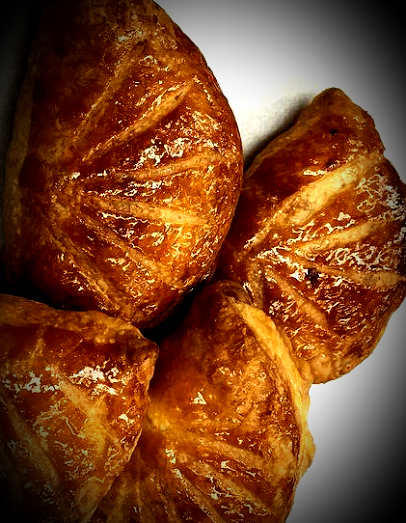
English Eccles Cake with Vanilla Custard Pudding Sauce (Recipe for the cake follows)
Almond Cream Cakelettes 


Two of my favorites from the menu are Floating Islands (Ile Flottante) and English Eccles Cake. The recipe for Ile Flottante is inspired by Downton Abbey while the English Eccles Cake is a modified version of the recipe found in the cookbook. Floating Islands is a dessert of light, airy meringues swimming in crème anglaise. The English Eccles Cake is not a cake so much as a puff pastry delicacy. I hope you enjoy them as much as we did.

Floating Islands (Ile Flottante)
Yield: 10 Servings
Ingredients
For the Crème Anglaise
750mL (1⅓ pint) milk
1 vanilla bean, scraped
8 free-range egg yolks
190g sugar

For the Meringue
8 free-range egg whites
1 tsp Cream of tartar
190g sugar

For the Caramel
75g sugar

Procedure
To Make the Crème Anglaise:
1. In a saucepan over medium heat, bring the milk, vanilla pod, and vanilla beans just to a boil.
2. Meanwhile, in a bowl, whisk the egg yolks and sugar together (blanchir) so they are well mixed and light in color.
3. When the milk comes to a boil, temper the egg yolk/sugar mixture. Do this by slowly adding the milk while whisking. You can also add the milk a little at a time and then whisk it quickly.
4. When the milk has been completely added to the egg yolks and sugar, return the mixture to the saucepan and heat until nappant. Nappant is when the mixture coats the back of the wooden spoon and stays separated after running your finger along the back of the spoon. It should reach a temperature of 170°F.
5. Place a bowl with a sieve over an ice bath.
6. Strain the crème anglaise through the sieve. Let the bowl sit in the ice bath to cool. Refrigerate until ready to use.

To Make the Meringue:
1. Preheat the oven to 350°F.
2. In the bowl of stand mixer, whisk the egg whites and cream of tartar to soft peaks..
3. Add the sugar to the egg whites one tablespoon at a time and continue whisking until the mixture comes to stiff peaks. The meringue will be thick and glossy. 
4. Using a pastry bag, pipe the meringue into lightly greased small silicone molds. If you don’t have a mold, you can pipe meringues into cloud-like shapes onto a silicone mat.
5. Bake in 350°F for about 10 to 12 minutes. They will puff like soufflés. Remove from the oven and let them cool down. Invert onto a plate and set aside. If you piped them onto a silicone mat, gently use an offset spatula to place them on the plate.

To Make the Caramel:
1. Pour the sugar into a clean saucepan.
2. Stirring with a wooden spoon, melt the sugar slowly over medium heat until it turns a dark copper color.
3. Remove the saucepan immediately from the heat to ensure the caramel does not burn.

To Assemble:
1. On a serving tray, pour a generous pool of crème anglaise.
2. Place meringues in the crème anglaise.  
3. Gently pour the caramel over the meringues. 


English Eccles Cake
Yield: 8 servings
Ingredients for the Cake
4 TBSP unsalted butter
1 Cup dried currants
2 TBSP candied orange fruit peel, chopped
1/2 Cup dark brown sugar
1/2 Tsp allspice
1/4 Tsp nutmeg
1/4 Tsp cinnamon
1/2 Cup brandy 
1 Lb frozen puff pastry, thawed
1/4 cup whole milk
1 large egg, beaten

Procedure
1. Preheat oven to 400°F.
2. In a saucepan over medium heat, melt butter.
3. Stir currants, fruit peel, brown sugar, allspice, nutmeg, cinnamon and brandy into melted butter. Mix thoroughly until sugar is dissolved and fruit is coated. Remove from heat.
3. On a clean, lightly floured surface, roll out thawed pastry until it is 1/4-inch thick. Cut out eight (5 inch) circles (Save remaining pastry dough for other recipes).
4. Dividing currant mixture evenly among circles, place currant mixture on one-half of the circle. Leave a ½ inch border.
5. Moisten edges of pastries with a little bit of milk and fold the circle to cover the filling. Pinch to seal.
6. Brush cakes with beaten egg, then sprinkle with white sugar. Make three parallel cuts across the top of each cake, then place on a baking sheet layered with parchment paper. 
7. Bake pastries in preheated oven for 15-20 minutes or until golden brown. Remove and sprinkle with a little more sugar, then serve.


I encourage you to have your own Downton Abbey tribute. Whether you dress up or keep it casual, I guarantee it is a great way to spend time while waiting for Spring to arrive.  


Saturday, February 14, 2015

Chocolate Bon Bons with Passion Fruit Ganache Filling

Happy (Belated) New Year! 2015 is a new year. We shift our focus and wipe the slate clean to start out on a new path. Yesterday is no more and tomorrow doesn't exist yet. Only today is our focus...living in the present as we embark on this new path day by day. How exciting!

Some dislike January but to me, it brings the hope of Spring. My chickens started looking for shoots in the still green-yellowish grass before the snows came. "Not yet," I told them. "We must wait during the cold months of January and February." 


They have hope. I, too, have hope. 


Where January symbolizes hope, February symbolizes love. Love of nature, life, people, home, knowledge, food, drink, gardening...what's not to love? It is our opportunity to give love to everything.


Hope and love are two beautiful forces that are one and the same. Chocolate is the physical manifestation of these two. I believe hope, love, and chocolate are the same force. They are my version of the three musketeers.


To me, chocolate bonbons with passion fruit ganache filling embody hope, love, and chocolate. Love is represented in the heart-shaped bonbons while hope is represented in the passion fruit filling. And of course, there is chocolate in all its glory: dark chocolate for the shell, milk chocolate for the ganache, and white chocolate for the decorations. Sometimes, I like to be creative and decorate my bonbons as though they are works of art. 


My wish for you is to taste love, hope, and chocolate in each of these bonbons.    


Chocolate Bonbons with Passion Fruit Ganache Filling

To watch how to make them, go to this link: 

Chocolate Shell
1,000 g Tempered dark chocolate (I prefer the seeding method:
https://www.youtube.com/watch?v=bydThAkiHzI&index=8&list=PLAWpIBpOvRSJa8KNjNwUtSojHovkMX2Ul)


Passion Fruit Ganache Filling
Yield: 460 grams
Enough for 60 bonbons

100 g Cream
10 g Honey
250 g Milk chocolate, chopped
100 g Passion fruit puree at room temperature
20 g Butter, cubed


Decorations
Gold luster dust
Gold leaf
Red and white chocolate
Small brushes

Procedure

1. Place milk chocolate in a large bowl and set aside.
2. In a saucepan over medium heat, heat cream and honey until the mixture simmers.
3. Pour cream over milk chocolate and let it rest undisturbed for 5 minutes.

4. With a small whisk, gently emulsify the chocolate, honey, and cream. Begin by whisking the mixture in the center only. Then, gradually broaden your whisking to incorporate all the chocolate in the bowl. 
5. Continue gently whisking until the chocolate is fully incorporated and the mixture is smooth and shiny.

6. Set aside to cool to slightly warmer than body temperature (100 degrees F) so it will be easier to pipe. 

Procedure for the Bonbons
1. Use clean, dry bonbon molds. Quickly pour the tempered chocolate shell into the mold. Make sure each of the individual sections are completely filled. 
2. Remove excess chocolate from the top of the mold with a spatula into a bowl.  
3. Tap the bonbon mold with the handle of your offset spatula to remove air bubbles. Once all the air bubbles are removed, pour the excess chocolate from the mold into a bowl. You want there to be a thin layer of chocolate in the mold for the bonbons.
4. Flip the mold upside down on a baking rack for about 2 minutes. After 2 minutes, clean the excess chocolate off using a scraper. Make sure the chocolate is flush with the mold so no excess is sticking up. This will ensure uniform bonbons.
5. Cut a small hole in a pastry bag (there is no need to use a piping tip for this). Pour the ganache in a pastry bag and pipe small mounds in each bonbon shell 3/4 of the way full. Make sure to leave space so the bonbon can be sealed with chocolate.
6. Pour tempered dark chocolate over the top carefully just to completely cover the bonbons. 
7. Once covered, tap the mold to remove air bubbles. Carefully scrape the excess chocolate into a bowl so the bonbons will be flat on the bottom. Keep your scraper flush with the mold to avoid disrupting the ganache filling.
8. Put the bonbon mold in the refrigerator for 10 minutes. When the molds look somewhat clear, the chocolate has shrunk away from the mold. They are ready to be unmolded. 
9. Remove the mold from the refrigerator. Turn the mold upside down to turn the bonbons out. 
10. Using a small brush, decorate the bonbons by brushing them with red or white chocolate. Gently brush gold luster dust or place gold leaf decorations for added effect. Enjoy! 


Tuesday, December 16, 2014

The Gingerbread Church

Have I said how much I love the holidays? I love the holidays! One of the things I look forward to the most is creating gingerbread structures. It has become my tradition since 2010. This year, I decided to replicate a historic 1900 Episcopal church as I love the architecture.


This is a week-long labor of love. I play holiday music while I work to get in the Christmas spirit. I spend days designing and constructing the church. In addition, I prepare a dessert buffet which I will present at the gingerbread church's unveiling. 

The walls and steeple are made out of gingerbread. Everything is in the details as some say, so I take my time carving the “bricks” and designs into the walls and steeple. Once I get started, I can’t stop. 


Nearly every church has stained glass windows and this one is no exception. The windows of my church are made from poured sugar. Poured sugar consists of cooking water and sugar to a high temperature, adding glucose, and cooking it even more. Once it reaches the desired temperature the poured sugar can be colored and poured into molds. In this case, the molds are cut-outs in the gingerbread church walls. Once the sugar has set the stained glass windows are complete. To highlight the beauty of the stained glass, I install lighting inside the church. 


The church is not complete until the doors, the roof and the landscape are decorated with royal icing. I get lost while decorating. Although it is time consuming I enjoy every minute of it.


The church doors:


Close-up of the landscape:


While the gingerbread church was being created, this came together for the edible edifice's unveiling: 

The Menu for the December 2014 Gathering:  

Passion fruit cheeseflan
* Mini lemon and blueberry jam trifles
* Milk chocolate mousse
* Stollen
* Almond cakelettes with an assortment of creams
* Pumpkin apple cake pudding 
* Egg nog
* Meringue cookies 'Brutti ma buoni'
* A village of cocoa-gingerbread houses petits fours
* Truffles
* Crystallized Almonds
Linzer tart and Flamande tart

One week later, the gingerbread church and the dessert buffet are ready for their unveiling at the rectory of Father Ron Pollock in Somerville, NJ:


From my friends and family to yours, I wish you the happiest of holidays!